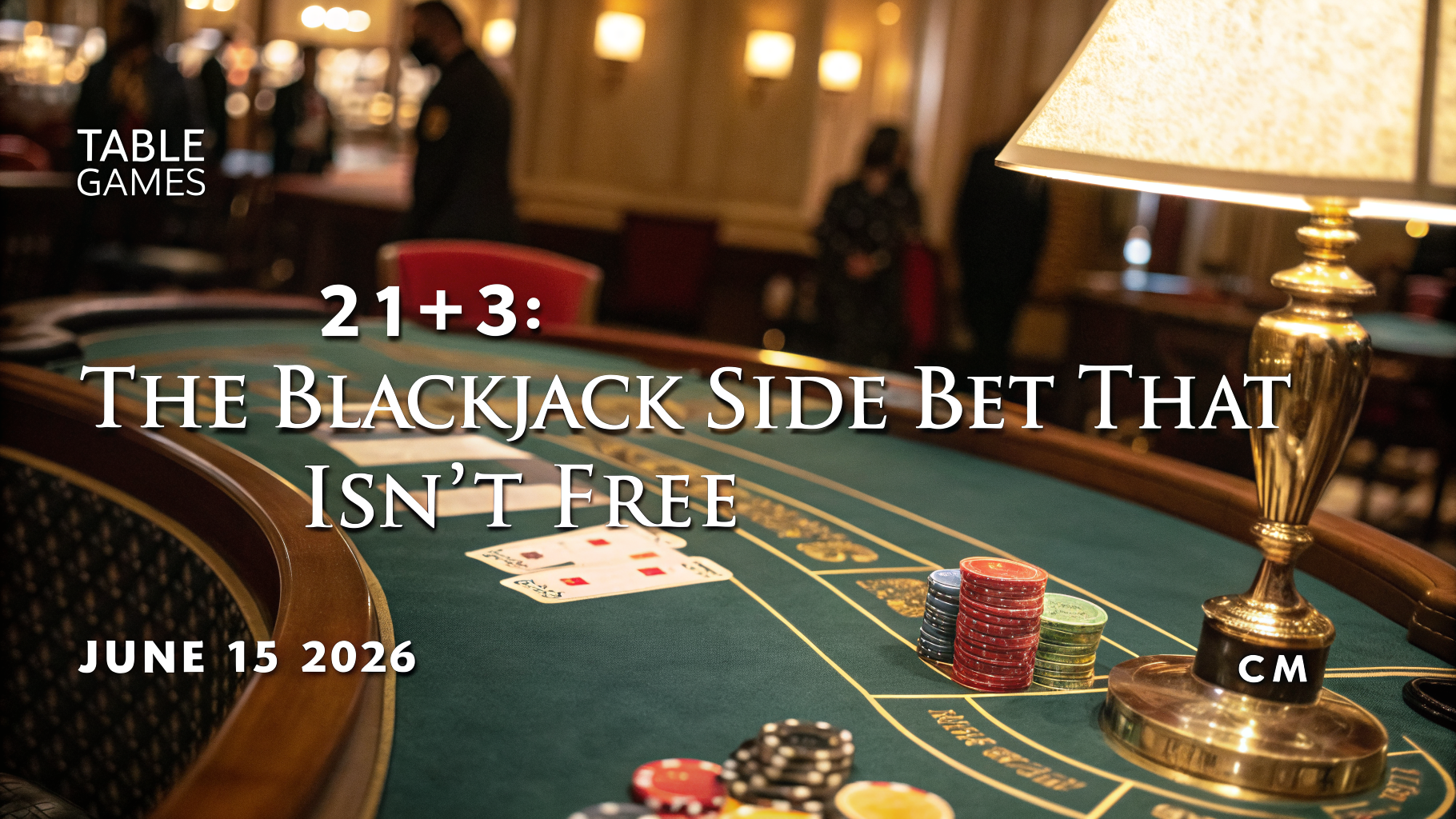
The 21+3 bet is the only wager on a blackjack table designed to be lost while you are winning.
It sits in a small circle beside your main bet, it pays in poker language, and it asks for almost nothing — a single chip, once, before the cards come out. That is exactly why the Master watches it so closely. The bets that feel free are the ones that cost the most. Before you place a chip in that circle, understand what you are actually buying.
What the 21+3 Bet Actually Is
The name is a ledger entry, not a slogan. “21” is the blackjack you are already playing. “+3” is a separate three-card poker hand built from your two cards plus the dealer’s up-card.
You place the side bet before any cards are dealt. Once the three relevant cards are on the felt, the dealer checks whether they form a qualifying poker hand:
- Flush — three cards of the same suit
- Straight — three cards in sequence, any suit
- Three of a Kind — three cards of the same rank
- Straight Flush — three in sequence, same suit
- Suited Three of a Kind — three of the same rank and the same suit (the rarest, on multi-deck tables)
If your three cards qualify, the side bet pays. If they do not, the chip is gone. And here is the part most players never hold in their head: the 21+3 result is completely independent of your blackjack hand. You can hit a flush on the side bet and still bust your main hand. You can win the hand and lose the side bet. They are two transactions wearing one chip rack.
The Payouts — and the Edge Hiding Behind Them
This is where the table earns its keep. There are two common paytables, and they are not close to equal.
The honest-looking one is flat 9:1 — any qualifying hand pays nine times your side bet. Simple, generous-sounding, and the worse deal of the two. Its house edge runs north of 13% on a six-deck shoe.
The more common one is tiered, and looks roughly like this:
| Hand | Typical payout |
|---|---|
| Flush | 5:1 |
| Straight | 10:1 |
| Three of a Kind | 30:1 |
| Straight Flush | 40:1 |
| Suited Three of a Kind | 100:1 |
That 100:1 line is the lure. It is also a hand you will see roughly once in several thousand. The combination you will actually hit — almost every time the bet pays at all — is the flush, the line at the bottom of the payout ladder. The big number on the board is the one you are least likely to reach; the small number is the one doing nearly all the paying.
Run the math on a standard six-to-eight-deck shoe and the tiered version carries a house edge of roughly 3.2% to 6.3%, depending on the exact paytable. Now set that beside the game you are sitting at: well-played blackjack runs a house edge near 0.5%. The Master has written before about how blackjack is the rare game where the edge bends to your decisions. The 21+3 circle is where players hand that advantage back — and then some. One chip in that circle can cost you six times the edge of the hand it sits next to.
The Mistakes the Master Watches at the Table
The Master has stood behind enough shoes to know the 21+3 circle attracts the same three errors every night.
Treating it as part of the hand. It is not strategy. No card you are dealt, no decision you make, changes the side bet — it is settled by three cards and pure chance. Calling it “playing 21+3” dignifies a lottery ticket.
Chasing the 100:1. Players who get burned on the flat payout start reaching for the suited trips. That hand is a rounding error. Betting toward it is betting toward almost never.
Betting it every hand. A small chip, placed every round for an hour, is no longer small. At the higher-edge paytables, a side bet repeated all night quietly outspends the main game it was meant to garnish. The damage is not in the size of the chip — it is in the frequency.
The Malaysia Read
You will find 21+3 on most multi-hand and live-dealer blackjack tables serving Malaysian players — it is a near-default add-on now, both on the floor at Genting and across the live studios. The presence of the bet says nothing about the table’s quality. What matters is two things you can check in seconds: which paytable is posted (tiered beats flat 9:1, every time) and whether you have the discipline to leave the circle empty.
If you want a live blackjack table where the main-game rules are fair before you even consider the trimmings, the Master’s notes point to Genting Crown and Maya Live. But fair rules on the hand do not redeem a bad side bet — they just mean the game you should be playing is the better one.
The Master’s standing rule: a side bet is entertainment you are renting, never a strategy you are running. Price it, cap it, and never let it outlast the hand.
You don’t beat 21+3. There is nothing to beat — no decision, no skill, no edge to claim. The discipline is not in playing it well. The discipline is in knowing it is a wager you make with your eyes open, for fun, with money you have already decided to lose — or one you walk past entirely. The Master walks past. Learn the game that rewards your decisions instead, and explore the strategy library before your next session at the table.