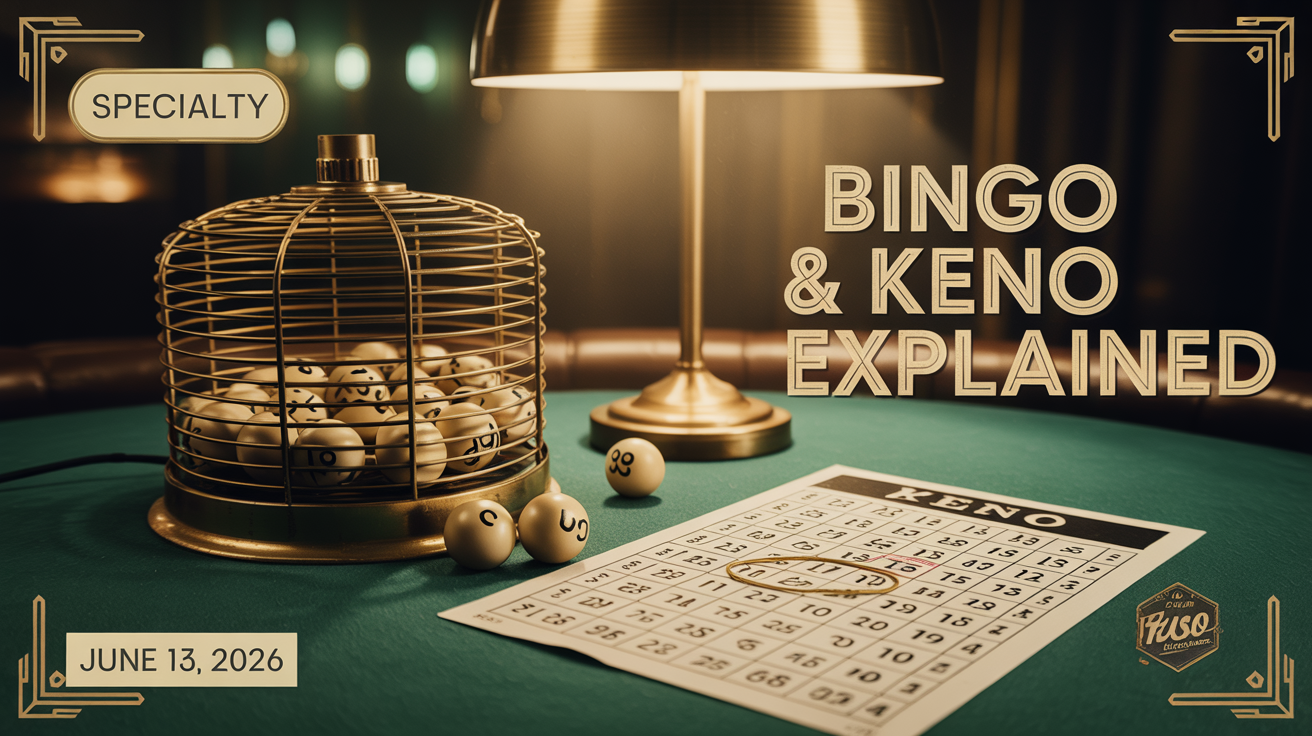
There are two games on the casino floor that ask nothing of you — no strategy, no decisions, no skill — and one of them will take a quarter of every ringgit you feed it. That game is keno. The other is bingo, which hides its edge behind a community hall full of friendly noise. The Master groups them together for a reason: they are the two purest games of chance in the building, and pure chance is exactly where players stop paying attention.
This is a guide to playing both with your eyes open. Not to win — you cannot make either of these a winning game, and any guide that tells you otherwise is selling something. The goal is to understand precisely what you are buying when you sit down, so the money you spend buys entertainment instead of regret.
How Bingo Actually Works
Bingo is a draw game. You hold a card — a 5×5 grid of numbers under the letters B-I-N-G-O — and a caller (or a random number generator, online) pulls numbered balls one at a time. You mark your card as your numbers come up. The first player to complete a defined pattern — a line, four corners, a full house — calls it and wins a share of the pool.
The mechanic you must understand is this: bingo is pari-mutuel. The prize comes from the players, not the house. Everyone buys cards, the money goes into a pool, the operator takes a cut off the top — often 20% to 40% — and the rest is paid back to whoever wins. You are not playing against the casino’s odds. You are playing against every other person in the room, and the house has already removed its slice before a single ball is drawn.
This changes how you should read it. More cards in your hand means more chances to win, but every other player can buy more cards too. More players in the room means a bigger prize, but also longer odds of it being yours. The house’s take is fixed regardless. Bingo is a game where your skill is precisely zero and your outcome is decided entirely by how many tickets are in play versus how many you hold.
How Keno Actually Works
Keno looks like a lottery, and that is essentially what it is. You pick numbers — usually between 1 and 15 — from a board of 80. The game then draws 20 numbers at random. The more of your picks that match the draw, the more you win, paid according to a paytable that depends on how many numbers you chose (“spots”) and how many you hit.
Here is the part the bright lights are designed to keep you from doing: the arithmetic. The odds of matching numbers in keno are brutal. Hitting all 10 numbers on a 10-spot ticket carries odds of roughly 8.9 million to one. The paytables are built so that even the rare big hit does not come close to compensating for the millions of small losses around it.
The result is a house edge that ranges from around 25% to 40% depending on the casino and the ticket. Put that beside the games the Master respects: blackjack played correctly sits near 0.5%, roulette on a single-zero wheel is 2.7%, baccarat’s banker bet is around 1%. Keno can be fifty times worse than blackjack. The same ringgit lasts a fraction as long.
What You’re Really Paying For
So why do these games exist, and why do people play them happily? Because they sell something other than odds. Bingo sells company — a rhythm, a room, a shared moment when someone shouts and everyone groans. Keno sells ease — you mark a ticket, you sip your drink, you glance up when the numbers flash, and you risk nothing more taxing than a pen stroke.
The Master does not sneer at this. There is a real place for a game you can play with half your attention while you talk to the person beside you. The mistake is not playing bingo or keno. The mistake is playing them while believing they are a fair shake at the house’s money. They are not. They are entertainment with a cover charge, and the cover charge is steep.
How To Play Without Being Played
If you choose to play either, play them as the Master does — as a fixed entertainment expense, never as a strategy.
- Decide the spend before you sit. Treat your bingo cards or your keno tickets the way you’d treat a cinema ticket: a known cost for a fixed amount of fun. When it’s gone, you’re done. There is no comeback in a game of pure chance.
- In keno, play fewer spots, not more. The eye-watering jackpots on 10- and 15-spot tickets are bait. Lower-spot tickets generally carry a gentler house edge and far steadier small returns. You won’t get rich; you’ll simply bleed slower.
- In bingo, the only lever you have is the room. Fewer players means better odds of winning but a smaller pool; more players, the reverse. Neither beats the house’s cut. Buy the number of cards you can comfortably track, no more — an untracked card is money you’ve already lost.
- Never chase. Both games are designed to feel “due.” No number is ever due. Each draw is independent of the last, and the cage has no memory of the ten cards you’ve already lost.
If you want a game where your decisions actually move the house edge, these are the wrong two — go and learn a real strategy game instead. If you want a relaxed evening where the math is simply the price of admission, bingo and keno will serve, provided you’ve read the receipt.
The Master’s verdict: Bingo and keno are not games you beat — they are games you budget for. Pay the cover charge knowingly, cap it before you start, and never confuse the warmth of the room or the ease of the ticket for a fair fight. The house priced the fun before you arrived.
You don’t outplay a game of pure chance. You decide, in advance, exactly how much that chance is worth to you — and then you let it cost you nothing more. That discipline is the only edge either game leaves on the table. For more on the games that sit alongside these, walk through the specialty room; for the games where skill earns its keep, the strategy tables are waiting.