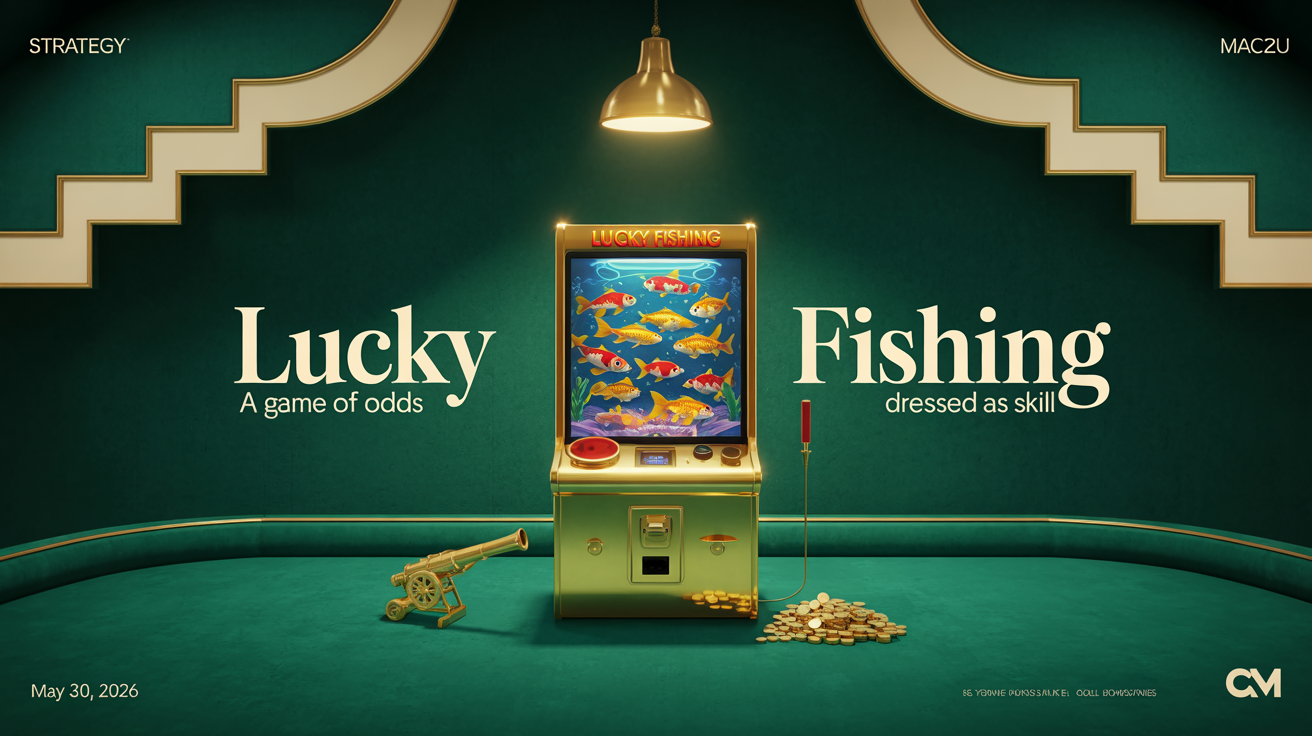
Fish-shooting games sell you a lie that no slot machine can: that the bullet you fired is the reason the fish died. The Master has stood behind enough cabinets and watched enough sessions to tell you plainly — your aim is the smallest variable in the room, and the room was built that way on purpose.
This is the rule you need before you ever spend a single ringgit on a fish cabinet, on Lucky Fishing, or on any of the dozen knock-offs that flooded the Asian arcade-casino market over the last decade: what looks like a shooting game is a probability-weighted lottery with a trigger. Learn that, and you stop overpaying for the trigger.
What “Lucky Fishing” Actually Is
Lucky Fishing is the generic Western label for the arcade-casino game category the Chinese-speaking market simply calls 捕鱼 — bǔ yú, “fish-catching.” It was born in Asian video arcades in the 2000s, ported to online casinos around 2015, and is now a permanent fixture in the live and instant-game lobbies of nearly every Asian-facing operator. You will see it under names like Fishing King, Royal Fishing, Fish Hunter, Boom Legend, Ocean King, and a hundred operator-branded variants. Lucky Fishing is one of them.
The cabinet — physical or digital — shows you an underwater scene. Fish swim across the screen at different sizes and speeds. Each species has a posted multiplier (x2 for a small clownfish, x100 for a golden dragon, x500 for a “boss” creature). You load credits, choose a bet size per shot, aim your cannon at a fish, and fire. If the shot “kills” the fish, you win your bet multiplied by the fish’s posted multiplier. If not, the credit is consumed and the fish swims on.
Players who have never read the math walk away convinced this is a skill game. The Master is going to show you why it isn’t.
Where Your Skill Ends and the Math Begins
Here is the single most important sentence you will ever read about fish-shooting:
Each shot is an independent probability event whose outcome was decided by an RNG before your bullet animation finished playing.
That is not a metaphor. Every regulated fish-shooting game — and every honest unregulated one — runs the same architecture as a slot. When you press fire, the server queries a random number generator. That RNG returns a result: kill or miss. Only then does the bullet animation play out to the fish. The visual of your cannonball striking the fish and the fish exploding into coins is the output of the RNG decision, not the cause of it.
What does this mean in practice? It means:
- You cannot “lead” a fish into your shot. The aim is cosmetic.
- You cannot “snipe” a boss with a charged shot. The cabinet may display a higher hit probability for a higher-bet shot, but that probability was set by the math model, not by your trigger discipline.
- Higher bet ≠ better player. Higher bet = the operator has shifted you into a higher RTP-weighted bracket where the kill rate per shot is mathematically inflated to match.
The Master has watched a player at a Penang arcade spend two hours convinced he had “found the trick” to a particular boss fish. He had not. He had spent enough credits to satisfy the law of large numbers. The boss eventually died because the RNG eventually said yes. He just attributed the result to the last shot.
The Three Real Variables
Strip away the cinema and only three things actually move your expected return on a fish-shooting game. Memorise these:
- The game’s posted RTP — usually 92% to 96% on online fish-shooting titles. Read it in the game’s info panel before you load credits. If it is below 92%, walk away. The Master’s standing rule.
- The bet-per-shot you select — most fish cabinets let you choose anywhere from x1 to x100. The total damage of your shot scales with your bet, but so does your burn rate. A x10 player runs out of credits ten times as fast as a x1 player.
- The session length you commit to — the most-overlooked variable. RTP is a long-run figure. A 95% RTP game does not mean you get back 95% of what you put in today. It means the population of all players, summed over millions of shots, gets back 95%. Your session of 800 shots is a tiny sample inside that distribution.
Skill belongs nowhere on that list. Discipline is the only edge the player has, and discipline expresses itself entirely through items 2 and 3.
The Lessons Players Pay To Learn
The Master has seen the same three mistakes at every fish cabinet from Genting to Macau, and he will name them so you do not have to learn them with your own money.
Mistake one: chasing the boss. A boss fish posts a multiplier of x250 to x1,000. New players see the number and start firing high-bet shots at it. The boss has a kill probability roughly inverse to its multiplier — that is the mathematical contract the operator must honour to keep RTP in range. If a boss pays x500, your effective per-shot kill probability is somewhere around 1 in 600. You will empty your tray before you ever land it.
Mistake two: spraying the small fry. The opposite mistake — assuming small fish at x2 and x3 are “easy money.” They are not. The kill probability is high, but so is the operator’s edge per shot at that bet sizing, and the multiplier is too low to recover your losses on the next miss. Small fry are bait, in both senses.
Mistake three: increasing the bet after a losing streak. The cabinet rewards this behaviour by often handing out a kill within the first three high-bet shots after a streak. It feels like the game owed you something. It did not. The RNG has no memory. You doubled your bet, you got lucky once, and the operator’s math is unbothered. Continue, and the regression reasserts.
Where Lucky Fishing Fits In Malaysian Play
In the Malaysian online-casino lobby, Lucky Fishing and its cousins sit in the “Arcade” or “Instant Games” tab — separated from slots, separated from the live tables, but charged to the same wallet. Every reputable Malaysian-facing operator that the Master has tested carries at least three fish-shooting titles, usually licensed from JILI, CQ9, Spadegaming, or KA Gaming. The studio matters less than the posted RTP and the bet-range. Stick to studios with regulator certification visible in the game info panel.
A specific note for Malaysian players: fish-shooting bonuses are almost always excluded from wager-requirement contribution. Read the bonus T&Cs before you assume your fish session counts toward clearing a welcome bonus. It usually does not. If you want to know how to read those T&Cs without being misled, the Master has written that lesson in full on the bonuses pillar and in how to read a welcome-bonus wager requirement.
The Master’s Standing Rule for Fish-Shooting Games
The Master’s verdict on fish-shooting: treat it as a slot machine with a moving target, and your discipline becomes a real edge.
Set a session budget before you load credits. Stay at the lowest bet bracket the cabinet allows for the first ten minutes — that is your reconnaissance, not your stake. Move up one bracket only if you are above your starting balance. Stop entirely the moment you are 30% below it. Refuse the boss chase. Refuse the bet-after-loss reflex. Ignore the cinema.
You do not master Lucky Fishing in a session. You master the shots you refuse to fire.
For the broader strategic framework on how the Master grades arcade-casino formats against slots and live tables, the strategy pillar lays out the comparison. If you are deciding which operator to load fish-shooting on, start from the casinos directory — every site the Master ranks has been tested for fish-game payout speed, not just slot payout speed.