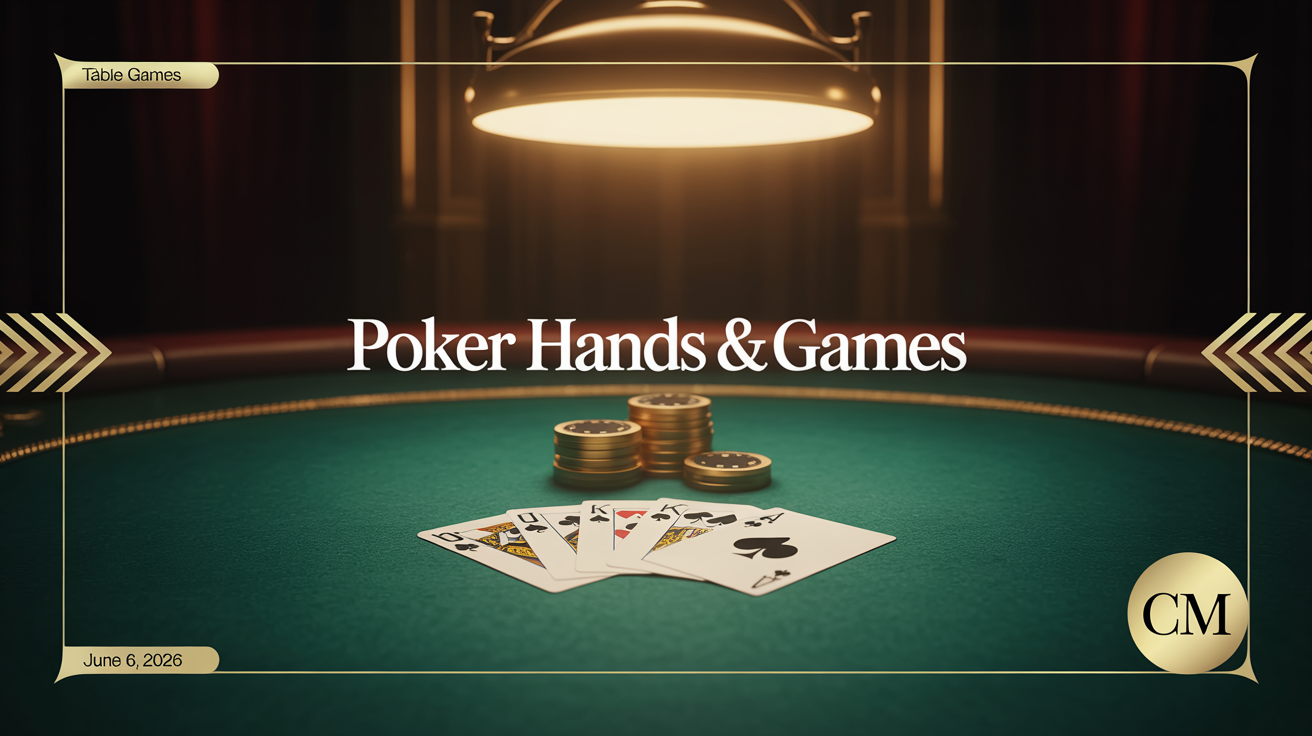
Poker is the only game on the floor where the house does not want you to lose to it. It wants you to lose to the player beside you.
That single fact changes everything. At roulette or craps, the casino is your opponent and the green pocket is the price of playing. At the poker table, the casino takes a small cut of each pot — the rake — and then steps back. Your money flows to the player who reads the table better, not to a built-in edge. The Master teaches poker as a game of two literacies: you must read the hands, and you must read the people. Most beginners learn only the first and wonder why they still leave broke. Start with the hands. You cannot read a table you cannot rank.
The Ten Hands, In Order of Strength
Every form of poker is decided by the same hand ranking. Memorise it the way a soldier memorises rank insignia — instantly, without thinking. From strongest to weakest:
- Royal Flush — A, K, Q, J, 10, all the same suit. The unbeatable hand. You may go years without holding one.
- Straight Flush — Five cards in sequence, all one suit (e.g. 6-7-8-9-10 of hearts).
- Four of a Kind — Four cards of the same rank (four kings).
- Full House — Three of one rank plus a pair (three queens, two sevens).
- Flush — Five cards of the same suit, any order.
- Straight — Five cards in sequence, mixed suits.
- Three of a Kind — Three cards of one rank.
- Two Pair — Two cards of one rank, two of another.
- One Pair — Two cards of the same rank.
- High Card — Nothing matches. Your highest card plays.
The logic is simple: the rarer the hand, the higher it ranks. A flush beats a straight because a flush is harder to make. When two players hold the same category, the higher cards win — a pair of aces beats a pair of kings, and if pairs tie, the next-highest “kicker” card decides it. The Master has watched newcomers misread a kicker and push chips toward a hand they had already beaten. Know the order cold before you sit.
The Games That Use Them
The ranking is universal. The games differ in how you receive cards and how the betting flows.
Texas Hold’em is the game you have seen on television and the one that fills most tables in Malaysia and across Asia. You are dealt two private “hole” cards. Five community cards are revealed in stages — the flop, the turn, the river — and you build your best five-card hand from any combination of the seven. It is easy to learn and a lifetime to master, which is exactly its appeal.
Omaha deals you four hole cards instead of two, but you must use exactly two of them with three community cards. The extra cards inflate the strength of winning hands, so a flush that wins in Hold’em is often second-best in Omaha. Beginners who carry Hold’em instincts into an Omaha game lose quickly.
Seven-Card Stud predates Hold’em and uses no community cards at all. Each player receives a mix of face-down and face-up cards across several betting rounds. It rewards memory and observation — you must track the up-cards your opponents have folded. It is rarer in modern rooms but still respected by older players.
Three-Card Poker and Casino Hold’em are different animals entirely. These are house-banked table games where you play against the dealer, not other players — and here the house edge returns. They are faster, simpler, and the Master treats them as table games rather than true poker. Useful to know the difference: in player-versus-player poker, your edge comes from skill; in house-banked poker, the maths favours the casino exactly as it does at any other table.
The Mistake That Empties a Seat
Here is the lesson the felt teaches expensively. The beginner’s ruin is not a bad hand — it is playing too many hands.
A new player sits down, feels the energy of the table, and wants to be involved in every pot. They call with weak cards because folding feels like missing out. Over a session this bleeds chips into stronger hands without the player ever making an obvious blunder. Discipline at poker is mostly the discipline of not playing — of folding mediocre cards before the flop and waiting for a position and a hand worth committing to.
The second mistake is ignoring position. Acting last in a betting round is a genuine advantage: you have seen what everyone else did before you must decide. The Master teaches students to play more hands from late position and fewer from early position. It is free information, and free information is the rarest thing at any table.
The Master’s standing rule: in poker, the money is not made on the hands you win. It is saved on the hands you refuse to play.
Where to Sit in Malaysia
Live poker rooms are scarcer than slot floors across Southeast Asia, which pushes most players online. When the Master evaluates an operator’s poker offering, three things matter: the size and traffic of the player pool (an empty room is an unplayable one), the rake structure, and whether the cash tables and tournaments suit your bankroll. A room with deep traffic and a fair rake is worth more than a flashy lobby with no one in it.
For players who want the table-game cousins — Casino Hold’em, Three-Card Poker, live-dealt against a croupier — the live casino studios deliver the cleaner experience. The Master has sat at the tables of Genting Crown and Dragon Tiger Imperial and found both honour their stated limits. Whatever you choose, read the table-games discipline before you read the lobby.
You do not learn poker in a night. You learn the hands in an hour, the games in a week, and the discipline of folding over a lifetime. Start with the order of the deck. Everything else is read from there.