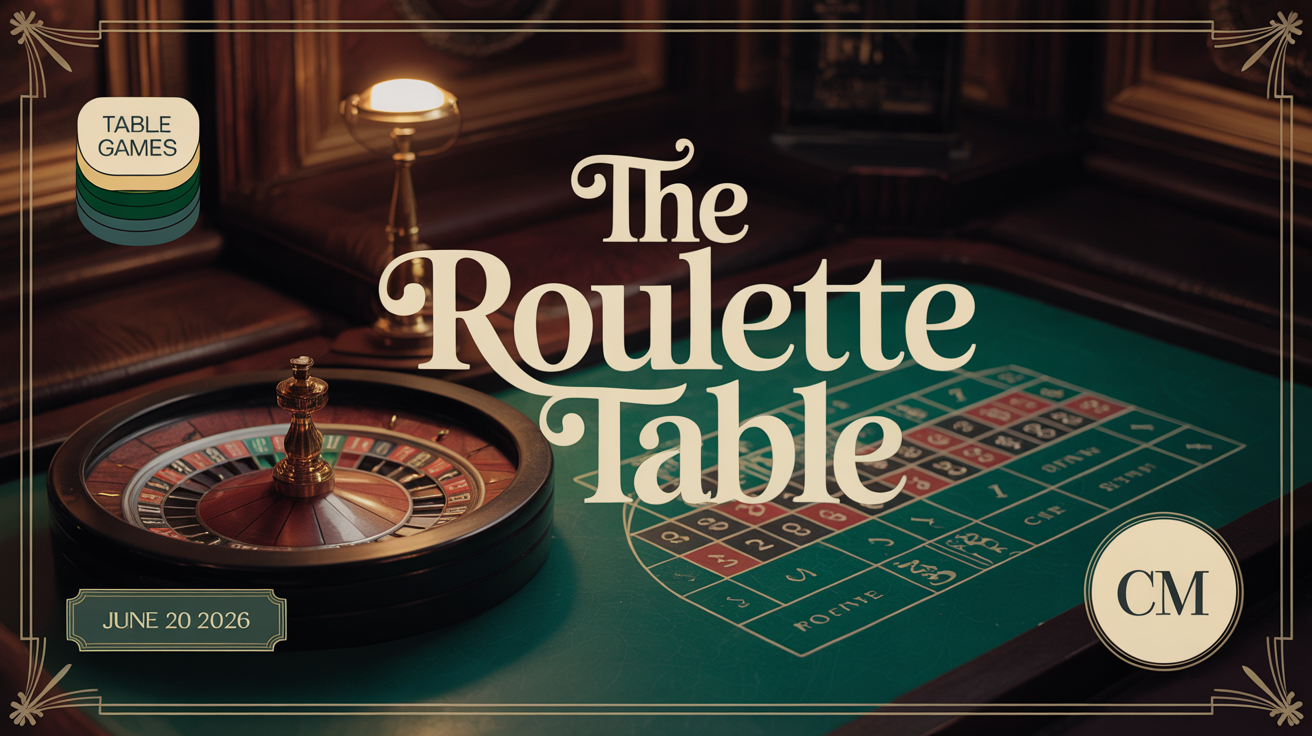
The roulette table is not decoration. It is a map of every bet the game will let you make, and the house has drawn it so the most tempting squares are the worst ones.
Most players sit down, find the red diamond, and push their chips at it. They never learn that the felt in front of them is laid out in two halves with two completely different verdicts. Before you place a single chip, the Master teaches you to read the table the way the croupier already does — as a grid of probabilities, not a game board.
The Two Halves of the Felt
Every roulette layout, in every casino from Genting to a live-dealer studio, splits into two regions.
The inside is the grid of individual numbers — 0 to 36, arranged in three columns of twelve, with the green zero (and, on American tables, a second green 00) sitting at the top. This is where you bet on specific numbers or small clusters of them. The payouts here are large: a single number pays 35 to 1.
The outside is the band of larger boxes around the number grid — red/black, odd/even, 1–18/19–36, the three dozens, and the three columns. These are the near-even-money bets. They pay 1 to 1 or 2 to 1, and they hit far more often.
Here is the lesson the layout hides: a straight-up number and a red/black bet carry the exact same house edge. On a single-zero European table, that edge is 2.7% no matter which square you touch. The table is designed to make the 35-to-1 squares feel like the real game. They are not. They are the same game with more variance.
Inside Bets — Reading the Grid
The inside grid rewards precision, and the Master wants you to know the names, because a live croupier will call them back to you.
- Straight up — one number, chip in the center of the square. Pays 35:1.
- Split — chip on the line between two numbers. Pays 17:1.
- Street — chip on the outer edge of a row, covering three numbers. Pays 11:1.
- Corner — chip on the intersection of four numbers. Pays 8:1.
- Line — chip on the outer corner spanning two rows, covering six numbers. Pays 5:1.
Notice the pattern. Every one of these is built so that payout × probability lands at the same 2.7% house cut. The grid is a fan of options that all cost you the same in the long run. Choosing between them is a choice about how wild you want the ride, not how much you expect to keep.
Outside Bets — Where Discipline Lives
The outside boxes are where a patient player belongs. Red/black, odd/even, and high/low each cover eighteen numbers and pay even money. The dozens and columns each cover twelve numbers and pay 2 to 1.
They will not make you rich in a single spin. That is the point. They keep you at the table longer on the same bankroll, and a longer session is the only thing that lets a bonus clear or a good night breathe. When you read about bankroll discipline, this is the section of the felt where it gets applied.
The Master’s standing rule: the outside of the table is for players who want to keep playing; the inside is for players who want a story. Know which one you came for before you sit down.
The One Square That Doubles the Edge
Look at the top of the grid. On a European table, there is a single green zero. On an American table, there are two — 0 and 00.
That second green pocket is the most expensive square on the felt, and you never even bet on it. It exists only to raise the house edge from 2.7% to 5.26% — nearly double — across every bet on the table. Same red/black bet, same straight-up number, twice the long-run cost.
The layout looks almost identical. The difference is one green box. The Master’s first instruction at any roulette table, live or online, is to find the zeros before you find your lucky number. One zero, you may sit. Two zeros, you walk — or you switch to a live-dealer European table where the wheel is honest about its math.
There is also a trap dressed as a bargain: the so-called “five-number bet” (0, 00, 1, 2, 3) that only exists on American tables. It carries a 7.89% edge — the single worst bet in the building. The layout offers it. The Master forbids it.
Where to Read a Clean Table in Malaysia
For the Malaysian player, the table that matters most now is the live-dealer one, streamed to your phone. The felt is the same; the camera just sits where the pit boss used to. The Master’s checklist does not change:
- Count the zeros. Single-zero European tables only. Reject American wheels.
- Find the table limits before you sit. The minimum and maximum are printed at the table — match them to your bankroll, not your mood.
- Confirm the operator is licensed. A beautiful table on an unlicensed site is a beautiful way to lose your withdrawal. The Master ranks operators on tested payouts, not table felt — see how that testing works across our table-games coverage and the full casino reviews.
For a deeper walk through betting systems and the wheel’s odds themselves, the Master’s full roulette guide takes over where this map ends.
The Master’s verdict: the roulette table is the most honest surface in the casino — it shows you the price of every bet in plain numbers. Learn to read the two halves, count the zeros, and you will already play better than most of the people who have sat at it for years.
You do not beat roulette by picking a better number. You beat the version of yourself that doesn’t read the table first.