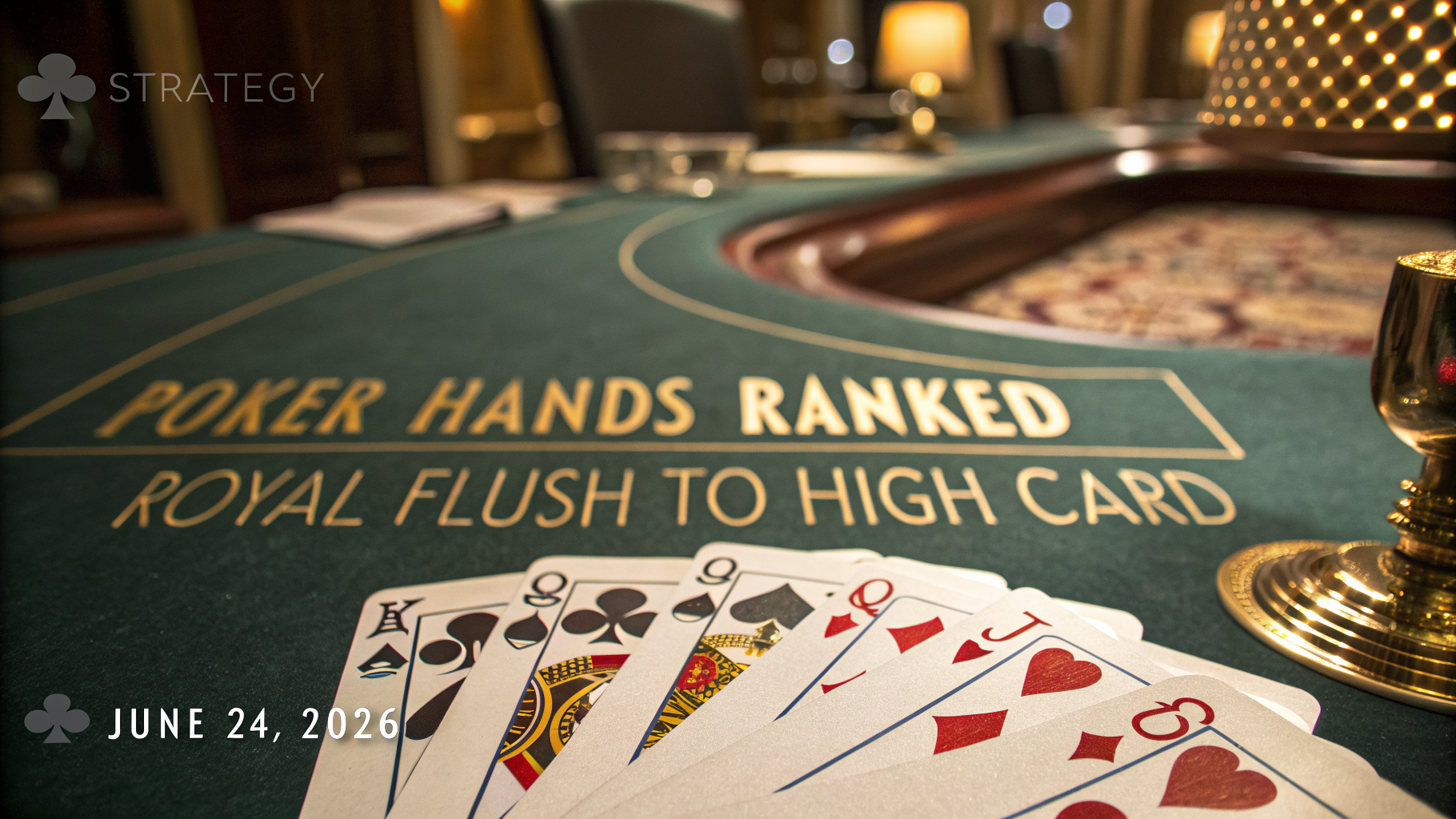
A poker hand is worth nothing until you know what beats it.
That is the first thing the Master teaches, because it is the one thing every losing player skips. They learn to bluff before they learn to rank, they chase a flush while a fuller hand sits across the table, and they call a raise holding two pair when the board has already paired a third time. Before you read a face, before you size a bet, you read the hand. Ten hands exist in standard poker. Learn them in order, learn the odds that sit behind them, and you have built the floor that every other poker skill stands on.
The Ten Hands, Strongest to Weakest
A poker hand is always five cards. Whether you are playing Texas Hold’em, Omaha, or a private game, the ranking below never changes — only the way you assemble your five cards differs.
- Royal Flush — A, K, Q, J, 10, all the same suit. The unbeatable hand. You will see roughly one in every 649,740 deals. Most players go years without holding one.
- Straight Flush — Five cards in sequence, all one suit (for example 6-7-8-9-10 of clubs). Beaten only by a higher straight flush, or the royal.
- Four of a Kind — Four cards of the same rank, such as four Queens. The fifth card, the “kicker,” settles ties between two quads of the same rank.
- Full House — Three of a kind plus a pair (three Kings and two Fives). Ranked first by the trips, then by the pair. Kings full of Fives beats Queens full of Aces.
- Flush — Five cards of one suit, not in sequence. The highest card decides ties; if those match, you compare the next card down, and so on.
- Straight — Five cards in sequence of mixed suits (4-5-6-7-8). The Ace plays high (10-J-Q-K-A) or low (A-2-3-4-5), but never wraps around — Q-K-A-2-3 is not a straight.
- Three of a Kind — Three matching cards plus two unrelated cards. Also called “trips” or a “set.”
- Two Pair — Two cards of one rank, two of another (two Jacks and two Sevens). The higher pair leads the comparison.
- One Pair — A single matched pair plus three unrelated cards. The most common winning hand at a full table is weaker than newcomers expect.
- High Card — No pair, no sequence, no suit. Your hand is named for its top card. Ace-high beats King-high.
The Master’s standing rule: a hand’s name is only half its value. The kicker — the unmatched card that breaks a tie — wins or loses more pots than any bluff.
The Odds Behind the Ranking
The order above is not arbitrary. Each hand outranks the next because it is rarer. The Master wants you to feel the scarcity, not memorise it as trivia, because scarcity is what tells you whether the hand across the table is plausible.
From a single five-card deal, a pair shows up about 42% of the time — nearly half of all hands. Two pair drops to roughly 4.75%. Three of a kind is around 2.1%. A straight is about 0.39%, a flush 0.20%, a full house 0.14%. Four of a kind sits near 0.024%, and the straight flush is a rounding error.
The lesson hides in those numbers. When you hold one pair, you are holding the most ordinary hand in poker. When the betting suddenly turns heavy on a board showing three suited cards, a flush — rare in the abstract — has become very possible, and your one pair is worth far less than it was a moment ago. Ranking is static. Likelihood is not. You read both.
The Mistakes the Master Sees at the Table
Three errors cost beginners more than bad luck ever will.
Misreading the straight-versus-flush order. A flush beats a straight. Always. The Master has watched players turn over a straight, reach for a pot, and freeze when a flush appears. Five suited cards are rarer than five in sequence, so the suit wins. Burn that in.
Forgetting the kicker. Two players hold a pair of Aces; the pot does not split automatically. The next-highest card decides it. An Ace with a King kicker beats an Ace with a Nine. Newcomers play their pair and ignore the card riding beside it, then wonder how they lost a hand they “tied.”
Chasing the bottom of the board. Holding three of a kind feels strong until the board pairs and someone quietly completes a full house that outranks you. The hand you hold matters less than the best hand the board makes possible. Always ask what beats you before you commit chips.
Where the Rankings Meet the Felt in Malaysia
Knowing the ten hands is the entry fee, not the edge. Poker is the rare casino game where the house takes a rake and steps aside — your money flows to the better player, not to a built-in margin. That is exactly why ranking literacy pays: every chip you win comes from an opponent who read the hands worse than you did.
If you want the wider lesson — the variants, the betting structure, the second literacy of reading people — the Master’s complete poker games and hands guide goes deeper. For the discipline that sits underneath all of it, the strategy pillar is where the Master keeps his standing rules, and the table games section covers the rest of the floor.
On the operator side, live poker and casino hold’em tables in Malaysia are thin compared to baccarat and slots, but they exist. The Master has sat at the tables run through Genting Crown and the high-limit rooms at Dragon Tiger Imperial — verify the current table list and stakes before you sit, as poker offerings rotate more than any other vertical.
The Master’s verdict: memorise the ten hands until the order is reflex, then learn the odds until rarity is instinct. Everything else in poker — position, bluffing, pot odds — is built on this single foundation.
You do not master poker the night you learn the rankings. You master it the night the rankings disappear, and you simply know — before the cards are even fully turned — exactly where your hand sits, and exactly what could beat it.