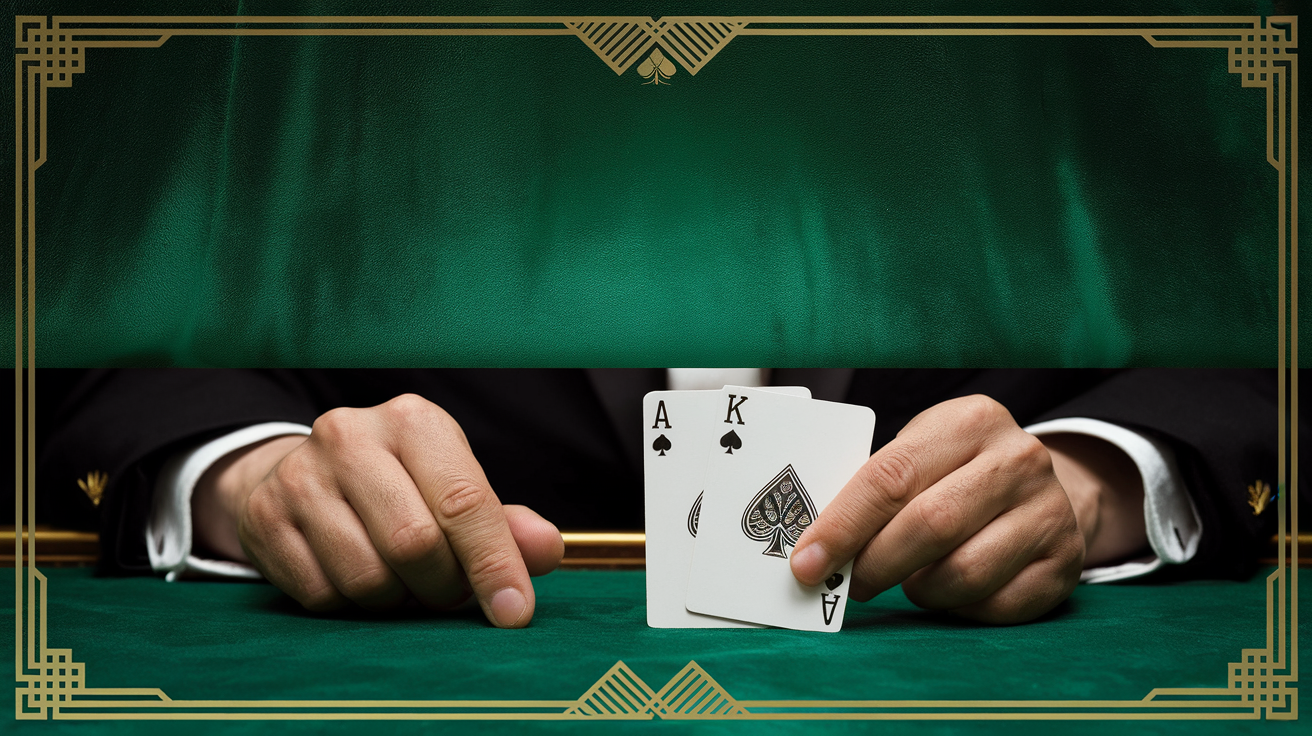
A blackjack hand is won or lost before the drama; it begins with whether you count the ace correctly.
Competitor pages for “blackjack cards value” usually stop at the classroom rule: 2 to 10 count as shown, J/Q/K count as 10, and ace counts as 1 or 11. That answer is true, but too thin for real play. The Master’s lesson goes further: card values decide whether a hand is soft or hard, whether a pair should be split, whether a dealer upcard is dangerous, and whether a tempting side bet is just expensive decoration.
Keep this guide beside the Master’s table games hub, blackjack guide, 21+3 side-bet lesson, poker hands guide, casino strategy hub, and responsible gambling vow.
The Basic Blackjack Card Values
Blackjack uses a simple value map:
| Card | Blackjack Value | What It Means at the Table |
|---|---|---|
| 2 through 9 | Face value | A 6 is worth 6, an 8 is worth 8 |
| 10 | 10 | Same value class as face cards |
| Jack, Queen, King | 10 | Different pictures, same blackjack value |
| Ace | 1 or 11 | The hand chooses the value that does not bust |
The goal is to beat the dealer without going over 21. A two-card 21 made with an ace and any 10-value card is blackjack. A three-card 21 is strong, but it is not usually paid as a natural blackjack.
Why the Ace Is the Master Key
The ace is flexible. Count it as 11 when the hand can carry it. Count it as 1 when 11 would bust the hand.
| Hand | Best Total | Hand Type | Why |
|---|---|---|---|
| A + 7 | 18 | Soft 18 | Ace can still drop to 1 if you hit |
| A + 7 + 3 | 21 | Soft-to-hard 21 | Ace still safely counts as 11 |
| A + 7 + 9 | 17 | Hard 17 | Ace must count as 1 to avoid 27 |
| A + A | 12 or soft 12 | Pair / soft start | One ace counts 11, the other 1 |
A soft hand contains an ace counted as 11 without busting. A hard hand either has no ace, or the ace must count as 1. This is why “I have 18” is not enough information. Soft 18 and hard 18 behave differently.
Hard Totals: When the Cushion Is Gone
A hard total has no flexible ace cushion. If you hold 10 + 6, that is hard 16. One more 10-value card busts it. The Master treats hard totals with respect because the next card has no forgiveness.
Common hard-hand lessons:
- Hard 12 to 16 are danger hands against a strong dealer upcard.
- Hard 17 or more usually stands because the bust risk is high.
- Hard 8 to 11 are the usual double-down neighbourhood, depending on dealer card and table rules.
- Hard totals become worse when the table pays blackjack 6:5 instead of 3:2.
For full table decisions, use this guide as the counting foundation and the blackjack guide as the strategy map.
Soft Totals: The Hand That Can Breathe
Soft totals let you take one more card with less fear because the ace can shrink from 11 to 1. That does not make soft hands automatic hit buttons. It means they are flexible.
| Soft Hand | Example | Common Discipline |
|---|---|---|
| Soft 13 / 14 | A+2, A+3 | Often hit; sometimes double against weak dealer cards |
| Soft 15 / 16 | A+4, A+5 | Often double when rules and dealer upcard favour it |
| Soft 17 | A+6 | Usually not a hand to freeze on blindly |
| Soft 18 | A+7 | Strong but not invincible; dealer 9/10/A changes the mood |
| Soft 19+ | A+8, A+9 | Usually stand except rare rule-specific cases |
The beginner mistake is treating every 18 as safe. Soft 18 against a dealer 10 is not the same as hard 18 against a dealer 6. Card value creates the strategy branch.
Face Cards: Different Faces, Same Ten
Jack, queen and king are all worth 10. In blackjack strategy, they are the same card value. The suit does not matter for the main game. A king of hearts and a jack of clubs both make 20 with a 10, both make blackjack with an ace, and both bust hard 12 into 22.
This matters because almost one-third of a standard deck is 10-value cards when 10/J/Q/K are grouped together. That is why dealer upcards of 10 and ace are so threatening, and why stiff hands bust so often when hit.
Pairs: Same Value, Different Decision
A pair is two cards of the same rank, not just the same value in every casino rule discussion. Two 8s are a pair. Jack + queen are both worth 10, but they are not normally treated as a splittable pair unless a table has unusual rules.
| Pair | Value Total | Master’s Lesson |
|---|---|---|
| A+A | 12 / soft | Usually split because two potential 21s are better than one awkward 12 |
| 8+8 | 16 | Often split to escape the ugliest hard total |
| 10+10 | 20 | Usually stand; breaking 20 is vanity |
| 5+5 | 10 | Usually treat as a 10 total, not a pair to split |
| 2+2 / 3+3 | 4 / 6 | Splitting depends heavily on dealer upcard and double-after-split rules |
The Master does not split because matching cards look tidy. He splits only when the value of two new hands beats the value of the current hand.
Dealer Upcard Values: The Other Half of the Count
Blackjack is not solitaire. Your card values matter, but the dealer’s exposed card gives context.
| Dealer Upcard | What It Usually Signals | Player Discipline |
|---|---|---|
| 2 or 3 | Mild weakness | Do not panic, but do not assume safety |
| 4, 5, 6 | Dealer bust pressure | Stand more often on stiff hands; let the dealer draw |
| 7, 8, 9 | Neutral to strong | Build a competitive total |
| 10 | Strong | Many weak totals are under pressure |
| Ace | Most dangerous | Insurance tempts players here; price it carefully |
A hard 16 against dealer 6 and a hard 16 against dealer 10 are both worth 16. They are not the same decision environment.
Blackjack, 21 and Payout Rules
A natural blackjack is usually an ace plus a 10-value card as the first two cards. On a proper 3:2 table, a RM100 blackjack pays RM150 profit. On a 6:5 table, it pays only RM120 profit. Same card values, worse price.
That payout difference is not cosmetic. It raises the house edge before you make a single decision. If two tables have the same card values but one pays 3:2 and one pays 6:5, the Master sits at the 3:2 table or walks away.
Also remember:
- A three-card 21 usually pays even money if it wins.
- Dealer blackjack can beat player 21 if the player’s hand is not natural blackjack.
- Some games let the dealer peek for blackjack; others resolve differently.
- Side bets may use poker-style card values and suits, not just blackjack totals.
Side Bets: When Values Change Their Costume
The 21+3 side bet uses your two cards plus the dealer upcard to form poker-style hands such as flush, straight, three-of-a-kind or straight flush. That means suits and ranks suddenly matter, even though they barely matter in the main blackjack hand.
This is where many players blur rules. Main hand: beat dealer by total value. Side bet: chase a separate pattern. The side bet can win while the main hand loses, or lose while the main hand wins. It usually carries a higher house edge than the main game.
The Master’s advice: learn card values for the main game first. Treat side bets as entertainment tax, not strategy.
Common Card-Value Mistakes
Mistake 1: Counting every ace as 11. The ace is 11 only while it does not bust the hand. A+9+5 is not 25; it is 15.
Mistake 2: Standing on every soft 18. Soft 18 is flexible, not sacred. Dealer upcard and table rules still matter.
Mistake 3: Splitting all 10-value cards. A 20 is already a commanding hand. Breaking it usually gives the house a gift.
Mistake 4: Treating 21 as blackjack. Natural blackjack is a two-card hand. A drawn 21 is not the same payout.
Mistake 5: Ignoring payout rules. Card values do not rescue a bad 6:5 table.
A One-Minute Practice Drill
Before playing for money, run this drill until it feels boring:
- Draw or imagine two cards.
- Say the total out loud.
- Say whether it is soft or hard.
- Add a dealer upcard.
- Decide whether the dealer card is weak, neutral or strong.
- Only then look at a basic-strategy chart.
The point is not to memorise everything at once. The point is to stop guessing the value of your own hand while money is already on the felt.
Final Verdict
Blackjack card values are simple on paper and expensive when misunderstood. Number cards count as shown, face cards count as 10, and aces count as 1 or 11. The real skill is seeing what those values create: soft totals, hard totals, pairs, dealer pressure, natural blackjack, and table-price decisions.
The Master’s rule: do not ask whether the hand feels close to 21. Count it, name it, then choose.
Master the values first. Strategy comes after the count is clean.